find_regions
Description
Part of the interactive API guide:
find_regions searches for subregions that resolve a feature's
heterogeneity and returns a Partition: a value with a tree, rules,
masks, and per region plots.
Reading time
Approx. 7' to read.
One feature, one search
On the bike sharing rig:
part = pdp.find_regions("hr")
part.show()
🌳 Full Tree Structure:
───────────────────────
hr 🔹 [id: 0 | heter: 0.47 | inst: 5000 | w: 1.00]
    workingday = no 🔹 [id: 1 | heter: 0.33 | inst: 1545 | w: 0.31]
        temp < 6.86 🔹 [id: 2 | heter: 0.22 | inst: 778 | w: 0.16]
        temp ≥ 6.86 🔹 [id: 3 | heter: 0.26 | inst: 767 | w: 0.15]
    workingday = yes 🔹 [id: 4 | heter: 0.34 | inst: 3455 | w: 0.69]
        yr = 2011 🔹 [id: 5 | heter: 0.23 | inst: 1720 | w: 0.34]
        yr = 2012 🔹 [id: 6 | heter: 0.31 | inst: 1735 | w: 0.35]

🌳 Tree Summary:
─────────────────
Level 0🔹heter: 0.47
    Level 1🔹heter: 0.34 | 🔻0.13 (28.12%)
        Level 2🔹heter: 0.26 | 🔻0.08 (22.91%)
Chips read [id | heterogeneity | #instances | weight], heterogeneity drops
as you walk down, and the rules speak your schema (workingday = no,
temp < 6.86 in °C). Every candidate split was scored by
heter_score(feature, mask) on the cached local effects:
zero model calls, whatever the tree size.
The Partition is a value
Nothing was stored on the engine. Don't like the partition? Search again with different settings; there is nothing to reset.
| verb | what it gives |
|---|---|
part.leaves |
the terminal regions |
part.label(idx) |
the rule as text: hr where (workingday = no) and (temp < 6.86) |
part.mask(idx) |
the boolean (N,) mask of region idx |
part.plot(idx) |
the feature's effect inside region idx |
part.eval(idx, xs) / part.eval_heter(idx, xs) |
the same, as numbers |
part.show() / part.show_axes() |
the tree, as text / as split axes |
part.to_dict() / Partition.from_dict / part.bind(effect) |
serialize, rebuild, re attach |
Regions are addressed by the id in the tree:
part.plot(2) # hr, inside (workingday = no) and (temp < 6.86)
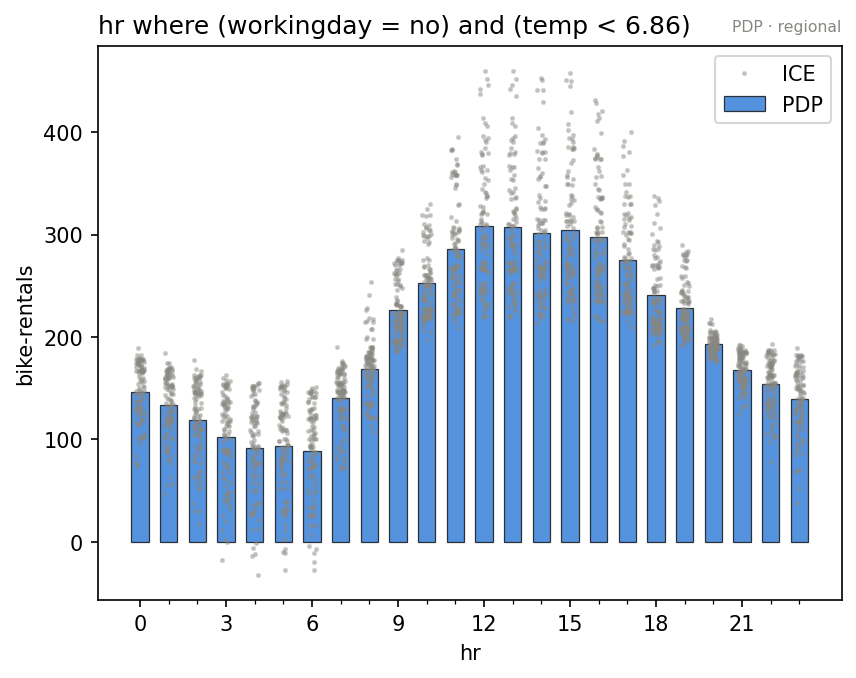
The global commute peaks are gone: on cold non working days the profile is one midday dome. This is the global plot's ICE spread, resolved into a subgroup with its own story. The report's regional analysis is exactly these plots, one per leaf.
Every engine finds the same cut
On the synthetic conditional interaction model of plot (the
slope of x_0 flips with the sign of x_1), all five engines land on the
same split, x_1 at zero, because that is the model:
x_0 🔹 [id: 0 | heter: 5.80 | inst: 1000 | w: 1.00]
    x_1 < 0.00 🔹 [id: 1 | heter: 0.30 | inst: 501 | w: 0.50]
    x_1 ≥ 0.00 🔹 [id: 2 | heter: 0.30 | inst: 499 | w: 0.50]
x_0 🔹 [id: 0 | heter: 5.79 | inst: 1000 | w: 1.00]
    x_1 < 0.00 🔹 [id: 1 | heter: 0.00 | inst: 501 | w: 0.50]
    x_1 ≥ 0.00 🔹 [id: 2 | heter: 0.00 | inst: 499 | w: 0.50]
x_0 🔹 [id: 0 | heter: 2.89 | inst: 1000 | w: 1.00]
    x_1 < 0.00 🔹 [id: 1 | heter: 0.14 | inst: 501 | w: 0.50]
    x_1 ≥ 0.00 🔹 [id: 2 | heter: 0.15 | inst: 499 | w: 0.50]
x_0 🔹 [id: 0 | heter: 6.23 | inst: 1000 | w: 1.00]
    x_1 < 0.00 🔹 [id: 1 | heter: 2.36 | inst: 501 | w: 0.50]
    x_1 ≥ 0.00 🔹 [id: 2 | heter: 2.47 | inst: 499 | w: 0.50]
x_0 🔹 [id: 0 | heter: 5.79 | inst: 1000 | w: 1.00]
    x_1 < 0.00 🔹 [id: 1 | heter: 0.00 | inst: 501 | w: 0.50]
    x_1 ≥ 0.00 🔹 [id: 2 | heter: 0.00 | inst: 499 | w: 0.50]
Several features at once
parts = pdp.find_regions(features="heterogeneous")   # {name: Partition}
parts = pdp.find_regions(features=["hr", "temp"])    # an explicit list
parts = pdp.find_regions(features="all")             # everything supported
Exactly one of feature= (singular, one Partition) or features=
(plural, a dict keyed by name) must be given. "heterogeneous" searches the
features with heter_score at or above the median: the same convention
effector.explain uses. On the rig it
proposes candidates for yr, hr, weekday, workingday, temp, hum.
A found rule plugs straight back into the other verbs:
pdp.plot("hr", rule=part.leaves[0].rule)
pdp.heter_score("hr", mask=part.mask(2))
Customizing the search
finder = effector.space_partitioning.Best(max_depth=2)
part = pdp.find_regions("hr", finder=finder)
finder:"best"(default) or"best_level_wise", or a configured instance fromeffector.space_partitioning.candidate_conditioning_features: which features may appear in a rule ("all", or a list); the report guide's bike sharing notebook restricts it to the categorical drivers.
A found split is a candidate, not a verdict
find_regions answers "where does this feature's heterogeneity
resolve?", one feature at a time. Whether a split earns its keep
against the whole model is a cross feature question:
select_regions, the next verb.
Where to next
select_regions: the next verb- The interactive API: back to the guide's map
- The regional analysis: these trees, in the report